


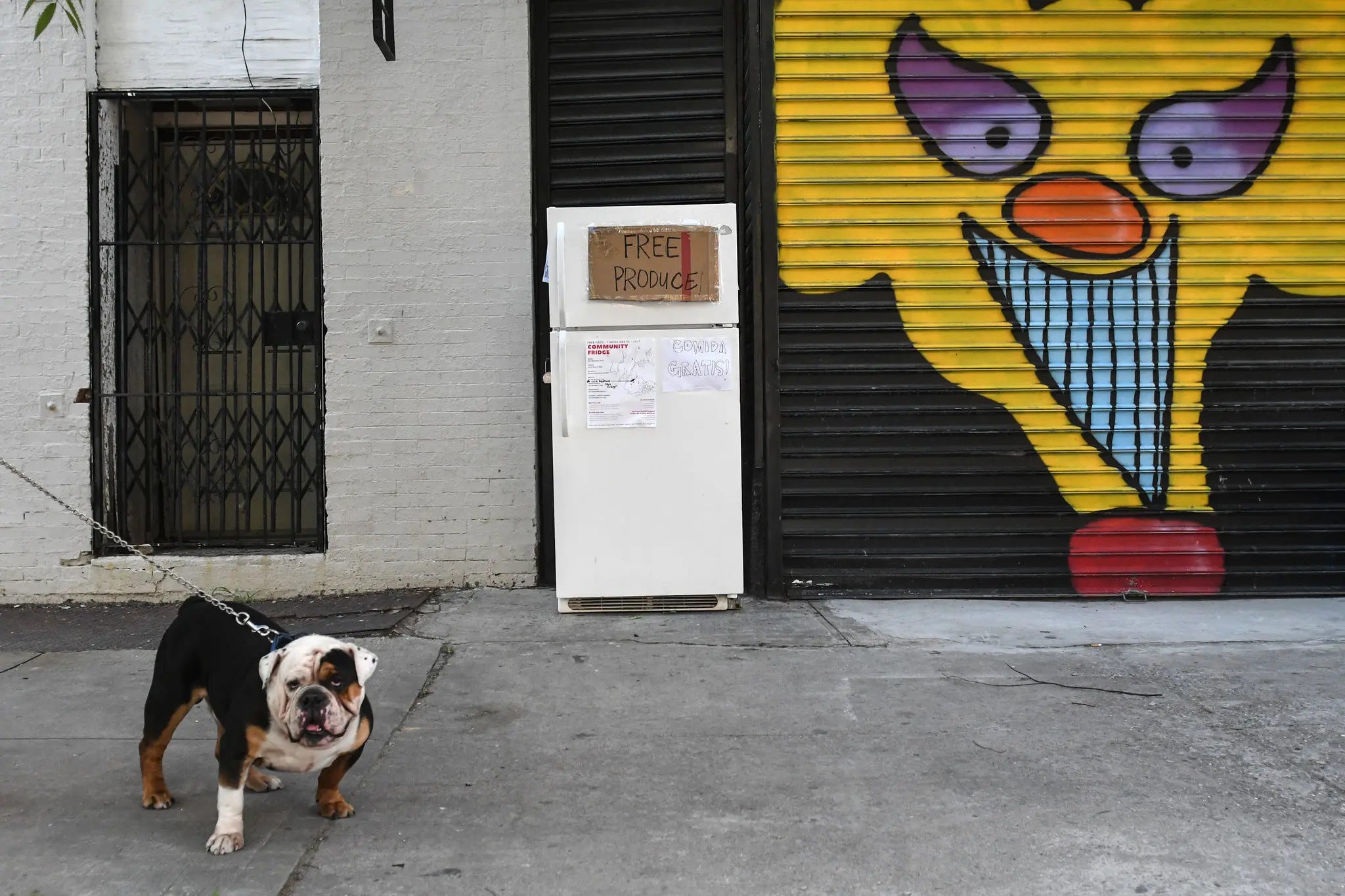
There are a few things more suspicious than a refrigerator sitting on a New York City sidewalk. Now an old sofa makes sense. A mattress makes sense, though you should probably keep walking. But a refrigerator plugged in and painted bright colors requires an explanation.
In the summer of 2020, as food insecurity was amplified by the COVID-19 pandemic, community refrigerators began popping up all over New York City. The refrigerators were stocked with free food and open to anyone in need.[i]
No paperwork or income verification was required.
People took what they needed and gave what they could.
Open the door, and you might find fresh produce, a prepared meal, or a few loaves of bread; or you might not find anything.
That is where the first 12 find themselves: in the wilderness and facing a hungry crowd.
Their conclusion is simple: “We have nothing here.”[ii]
The scene begins with Jesus trying to get away. John the Baptist has been murdered. Herod has thrown himself a birthday banquet, and the party ends with John’s head carried into the room on a platter.
There is food, wine, status, and power. And it all ends in death.
When Jesus hears all of this, he withdraws by boat to a deserted place; maybe he needed to grieve or pray or simply have a few hours to himself, but the crowd followed.
Jesus returns to shore, and thousands are waiting for him. Matthew says Jesus has compassion on the crowd. He does not see them as an interruption. He sees sick, frightened, and desperate people. He doesn’t offer concern from a safe distance; he moves toward the crowd and stays with them.
By evening, the disciples have seen enough; they say, “Send the crowds away to go into the villages and buy food for themselves.”[iii]
Their response is perfectly reasonable. The disciples are not being cruel. They are being practical.
We cannot fault their logic. It is late. They are in the middle of nowhere. The crowd is hungry. There are no restaurants nearby.
Send them away; let someone better equipped for large-event catering handle the situation.
Jesus does not send them away.
That is Grace.
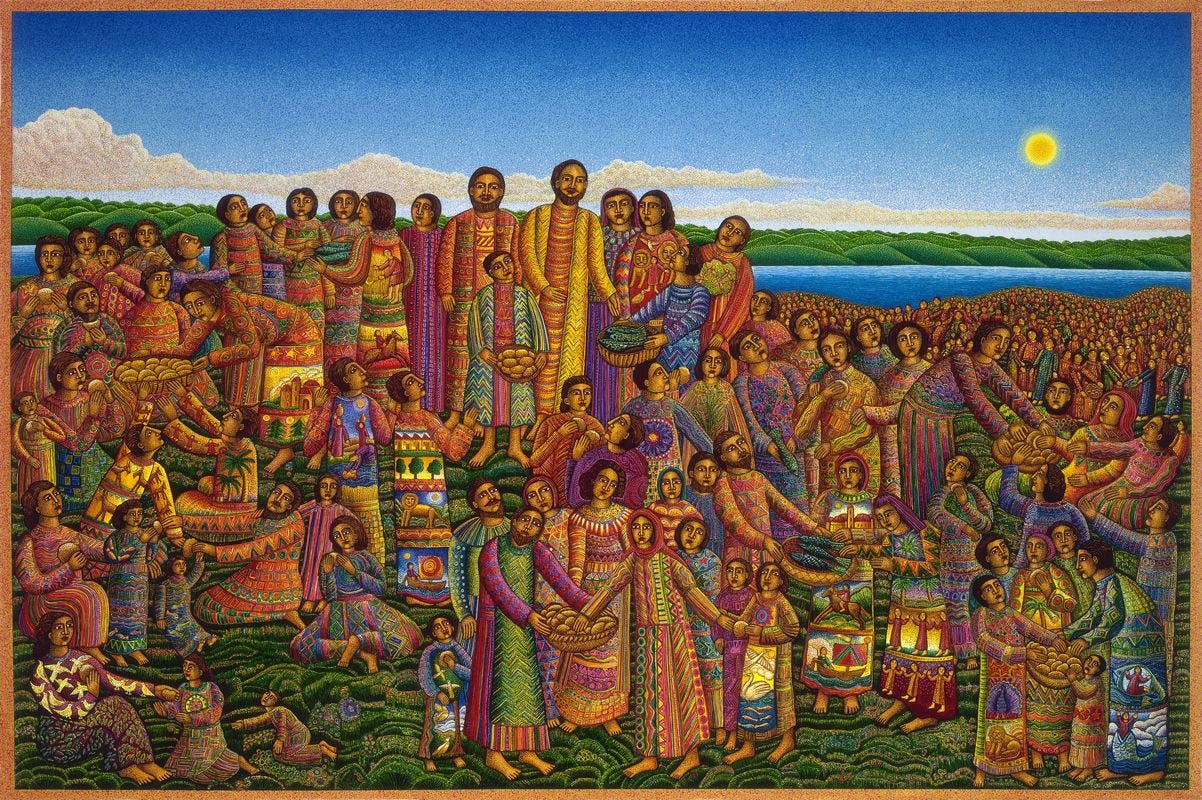
Jesus refuses to allow hungry people to be treated as a problem to relocate. He will not allow the disciples to outsource the needs of the crowd.
Then Jesus stands the disciples on their heads: “Give them something to eat.”[iv]
Matthew tells us there are 5000 men besides the women and children in this crowd. This is not a post-church cookout on the lawn where everyone forgot to bring a side to share. This is the population of Del Ray. A small city sitting on the grass.
So disciples take inventory, “We have nothing here but five loaves and two fish.”[v]
Notice their words.
They do not say, “We have five loaves of bread and two fish.”
They say, “We have nothing except five loaves of bread and two fish.”[vi]
They do have something, but compared to the need, it looks like nothing. So, the disciples round down to zero.
That is the language of scarcity.
Nothing except aging buildings.
Nothing except the same volunteers who always show up.
Nothing except a budget that’s already spoken for.
Nothing except too few children.
Nothing except the new pastor who we are still not sure about.
The original 12 are forever our mirror because they, and we, are forever mistaking not enough for nothing.
To be fair, five loaves and two fish are not enough to feed 5000 plus people. We all know that. That is not up for debate.
This is not a story about believing in yourself. Jesus does not tell the disciples to think positively or to discover their own power from within.
They are not enough, and that is the point.
The need before them is larger than their ability. The hunger exceeds their resources. They cannot do what Jesus has commanded them to do.
The disciples are right about their inadequacy; but they’re wrong about Jesus. Jesus says, bring them here to me. That is, the gospel!
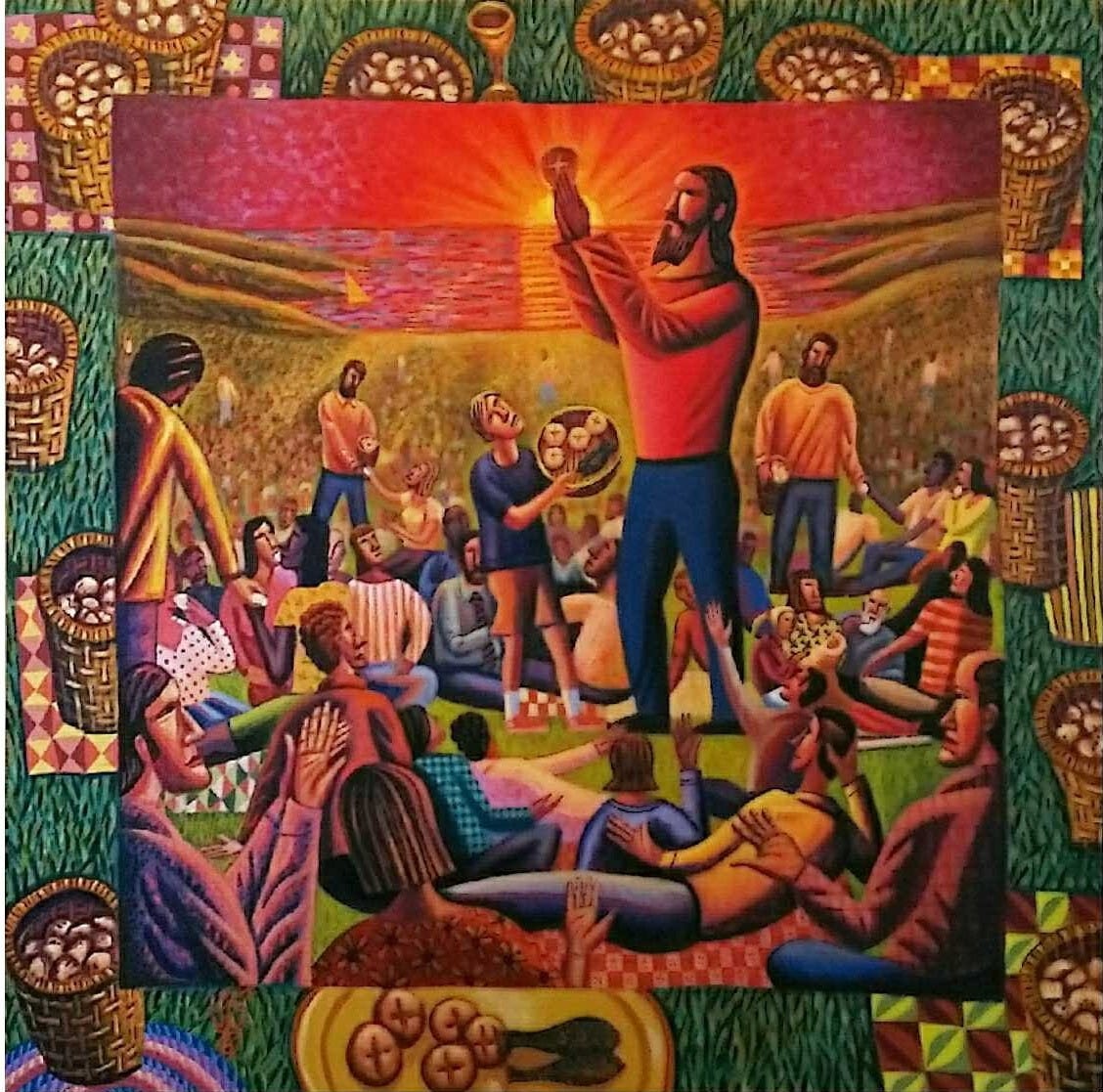
Jesus doesn’t scold them or tell them to try harder; he says, “Bring them here.”
Bring me what you have already dismissed.
Bring me your not enough.
Bring me your nothing.
The miracle does not begin with the disciples finding their hidden potential. It begins when what they have is placed into the hands of Jesus.
Too often, this scene is reduced into a lesson about sharing: maybe the crowd had food and one person shared the food, and then everyone else followed. That would be a lovely story of human generosity.
It’s just not Matthew’s story.
Matthew is proclaiming that Jesus is Lord of all creation, even in the wilderness. Even when the cupboard is bare. Even when the disciples have reached the end of what they can do.
The good news is not that everyone pitched in.
The good news is Jesus.
Jesus tells the crowd to sit down. Then Matthew tells the story. Jesus takes the bread. He blesses it. He breaks it. He gives it.
Matthew is pointing us towards another table.
One night when Jesus is betrayed, he will take bread, bless it, break it, and give it to his disciples, saying, “Take, eat; this is my body.”[vii]
This wilderness meal leans us toward the upper room.
Jesus is not merely showing that he can produce bread. He is showing us who he is.
Jesus is the One who feeds people in the wilderness. He does not send them away hungry. He will give them himself.
The disciples receive bread from Jesus and pass it to the crowd. That is their part. They do not create abundance or save the day. They receive what Jesus has given and pass it along.
That is the Church on its best day.
We are not the bakery or even the bread. We are beggars, handed bread, and told to pass it down the line.
Everyone eats until they are filled.
Then the disciples gather 12 baskets of leftovers, 12 baskets, one for each disciple who said we have nothing here.
Yes, five loaves of bread and two fish would be insufficient, but insufficiency is not the end of this story.
There are two banquets in chapter 14. Herod hosts one in his palace. Jesus hosts another in the wilderness.
Herod’s table has abundance and power and ends with a dead prophet. Jesus’s table begins with nothing, and it ends with thousands fed and 12 baskets of leftovers.
Herod’s table is full, but it deals death. Jesus’ table looks empty, but it gives life.
And now Jesus gathers us at His table, and we come with the disciples’ confession: we have nothing.
We come with empty hands, which is not a problem at this table because empty hands are the only hands that can receive a gift.
Jesus is the host. Jesus is the giver. Jesus is the bread, and no one has sent away.
Bring your hunger, the faith you wish was stronger. Bring the five loaves and the two fish that seem like nothing. “Bring them here to me,”[viii] Jesus says.
Those community refrigerators in New York City carried a beautiful promise: take what you need and leave what you can, but someone could still open the door and find the refrigerator empty. Human generosity is beautiful but finite; somebody eventually has to stock the shelves.
But the promise of Christ’s table is better. The host provides the meal, and the host gives himself.
We come saying we have nothing. Here, Jesus says, “Bring all of it to me.”[ix]
The good news is that you have more than you think.
The good news is that Jesus is more than you imagine.
Where Jesus is, the hungry are fed, sinners are welcome, grace is given, and there’s always more bread than we dared to expect.
So come to the table and bring your nothing. Take. Eat. Be filled.
Amen.
[i] Amanda Rosa, “See That Fridge on the Sidewalk? It’s Full of Free Food,” photographs by Stephanie Keith, The New York Times, July 8, 2020, https://www.nytimes.com/2020/07/08/nyregion/free-food-fridge-nyc.html
[ii] Matthew 14:17, NRSVue
[iii] Matthew 14:15
[iv] Matthew 14:16
[v] Matthew 14:17
[vi] Ibid.
[vii] Matthew 26:26
[viii] Matthew 14:18
[ix] Ibid.


