


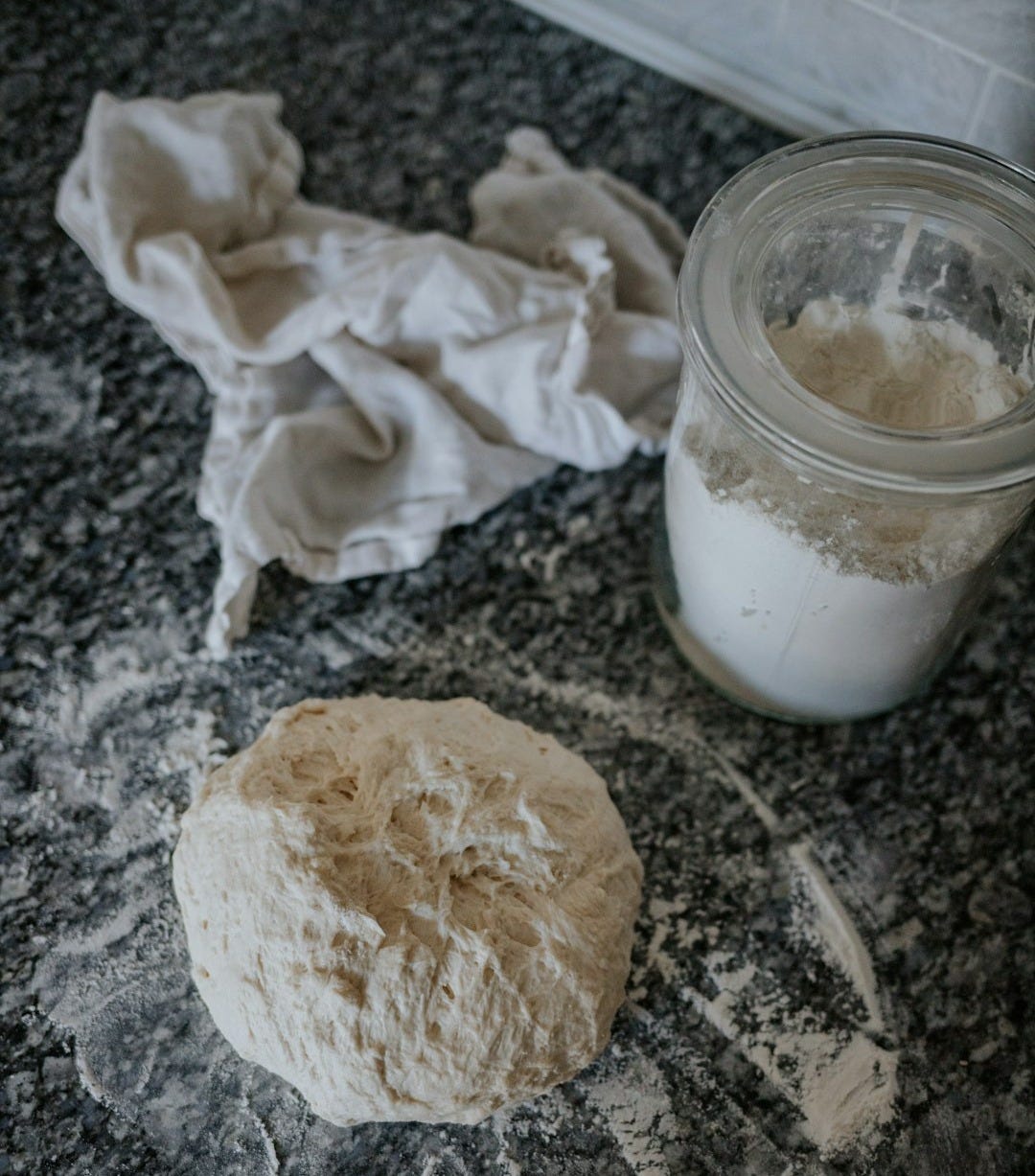
During COVID, many of us lost our minds in very specific ways. Some purchased Peloton bikes that now serve as a secondary closet. Speaking of closets, some reorganized theirs with Marie Kondo’s help. Some became amateur public health experts on Facebook, which was every bit as helpful as you remember. Then, there were the sourdough people.
You remember the sourdough people, don’t you?
All at once, everybody had a starter. Jars of beige goo on kitchen counters were given names and displayed with the pride of a newly adopted pet. The sourdough people posted pictures online, accompanied by details of hydration percentages and crumb structure. People who before the pandemic could barely open a bag of store-bought pre-sliced sandwich bread were saying things like, “I need to discard before I feed.”
In a time when so much felt beyond our control, there was beauty in people finding comfort in something ancient and ordinary. Flour. Water. Time. Patience.[i] Bread rising on the counter when the rest of the world felt like it was falling apart.
But here is what few of the sourdough people will ever admit: it is not exactly impressive.
It is not glamorous. It is not clean. It does not look like the Kingdom of Heaven. It looks like something you forgot in the back of the refrigerator.
It bubbles. Ferments. Smells strange. Sometimes a layer of liquid forms on the top, which is just gross.
And yet, if you know what you are doing, that bubbling, sour-smelling stuff can work its way through an entire lump of dough, turning flour and water into bread.
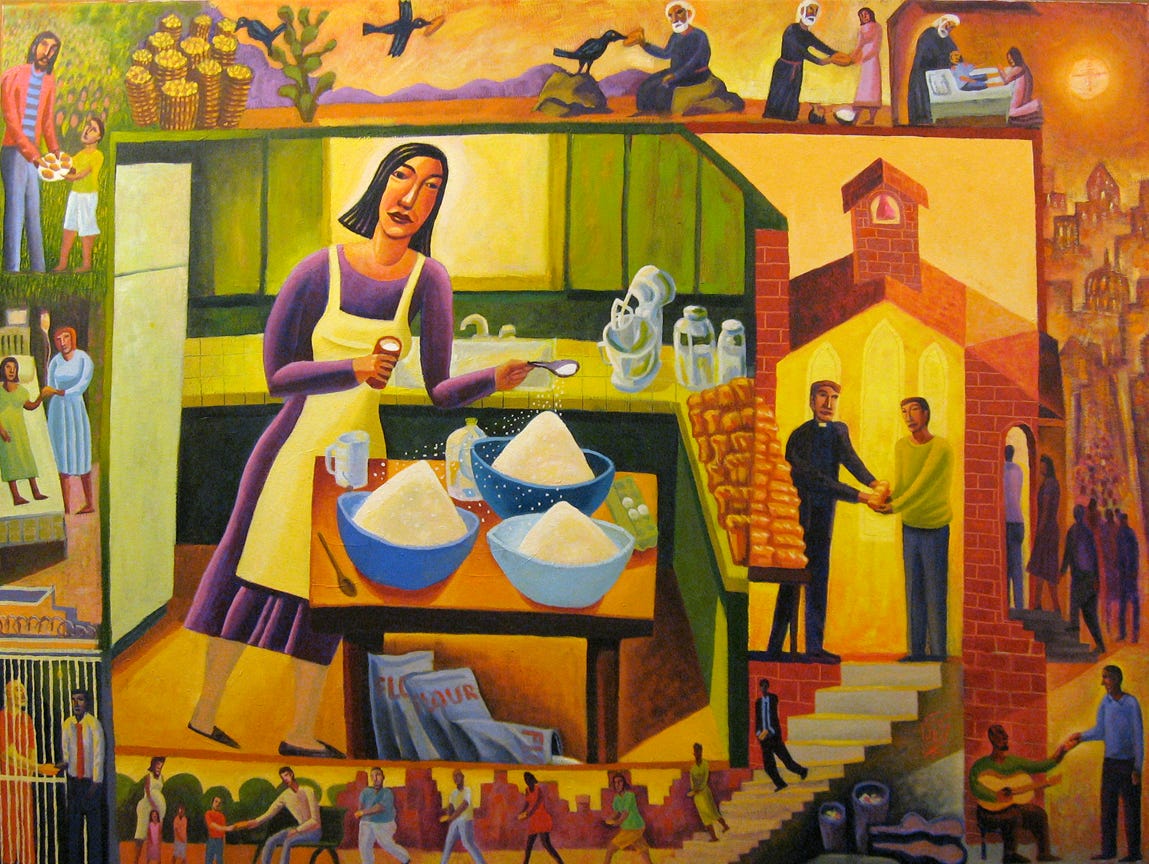
Jesus says, “The kingdom of heaven is like yeast that a woman took and mixed in with three measures of flour until all of it was leavened.”[ii]
Now, because we are modern people with refrigerators and artisan flour, we hear that and think, “How lovely and quaint.” The Kingdom of Heaven is like an episode of The Great British Baking Show.
How cozy.
How domesticated.
We think that is the perfect recipe for the church cookbook.
A little yeast goes into some flour, the dough rises, and everyone gets warm bread.
Isn’t that nice?!
Unfortunately, Jesus is not being nice, quaint, or cozy.
Jesus’ parables are not stories intended to confirm what we already think. Jesus’ parables are a bull in the china shop of our assumptions about God. And this bull starts breaking stemware the moment we realize the leaven, in Scripture, is rarely a positive image.
Leaven was associated with corruption, impurity, fermentation, and decay. At Passover, Israel was commanded to remove leaven from the house.[iii] Paul warns the Corinthians that “a little leaven leavens the whole lump,”[iv] and he does not mean that as a compliment.
So, when Jesus says, “The kingdom of heaven is like yeast that a woman took and mixed in with three measures of flour until all of it was leavened,” He is not reaching for the usual symbol of goodness.
Jesus is saying that the Kingdom of Heaven is something suspect.
Something hidden.
Something that gets mixed in before anyone can stop it.
Something that changes the whole thing from the inside out.
Which is to say, the Kingdom of Heaven is not impressive. It is invasive.
And pay attention to what Jesus says: “The kingdom of heaven is like yeast that a woman took and mixed in with three measures of flour until all of it was leavened.”
The late Episcopal priest Robert Farrar Capon wrote, “This is a baker, folks.”[v] Not someone making bread for their kids’ lunchbox. Three measures of flour are a ridiculous amount. A bushel. Enough to feed the neighborhood. Enough dough to make your shoulders, arms, and hands ache thinking about kneading it.
The Kingdom of Heaven is like a woman in a kitchen hiding leaven in a ridiculous amount of flour and water.[vi]
God’s kingdom comes through what we and others might overlook.
A woman.
A kitchen.
A pile of flour.
A little bit of leaven.
And then, before anyone notices, the whole thing is being changed.
The whole thing. Meaning, the whole of creation. Not an artisan loaf of sourdough bread with a cool design carved into the crust. The whole lump of creation: stubborn, heavy, ordinary, resistant, and in need of being made into something it cannot make of itself.
Christians can spend a lot of time deciding which part of the lump God is allowed to leaven.
Surely, God is at work among respectable people.
Surely, God is at work among people who already believe the right things, vote the right way, pray the right prayers, and know when to stand during worship.
Surely God is at work in the church, or at least in the parts that do not make us roll our eyes.
But Jesus does not say the woman hides the leaven in a carefully selected corner of the dough.
Jesus says she hides it in the whole thing.
Capon put it like this: there is “not one scrap of this lump of a world unleavened.”
Did you hear the danger in that sentence?
Because if it is true, God is not waiting for our permission to get started, which means the Kingdom of Heaven is not dependent on us.
If it is true, then grace is not locked inside the church building until we figure out the best method of distribution.
If it is true, then Jesus is already hidden in the places we have written off. Jesus is already working in the people and places we have dismissed. Jesus is already present in the neighborhoods we are told not to turn toward, already mixed up in the parts of the world we assume are too messy, too secular, too broken, too far gone.
And that is both good news and a tad insulting.
It is good news because it means the Kingdom of Heaven does not depend on us getting everything right.
It is insulting because we enjoy thinking that the Kingdom of Heaven depends on us getting everything right.
We like to imagine ourselves as the yeast. We like to imagine that if we were just faithful enough, strategic enough, welcoming enough, busy enough, we will finally bring the Kingdom of Heaven to life in our corner of creation.
But Jesus does not say the Kingdom of Heaven is like a church committee implementing a leavening plan. He says the Kingdom of Heaven is like a lump of moldy yeast hidden in the dough.
The Word is already at work.
Jesus is already mixed into creation.
Grace is already fermenting in the world.
The question is not whether we can make the kingdom come. The question is whether we can trust that the kingdom is already here, already working, already rising in ways we may not see and certainly cannot control.
Capon says the responses required of us are mostly patience and discernment. Patience, because, well, we usually aren’t, and yeast works on its own schedule. Discernment because we need eyes to recognize what the yeast has done.
The hardest part might be believing that the leaven is actually working when the lump still looks like a lump.
When the world still looks violent.
When the church still looks anxious
When the people of God still look like people who have missed the point.
When your own life still feels heavy, resistant, and not especially risen.
The temptation is to say, “Surely, this isn’t working. Surely God must not be here. Surely grace has failed. Surely the kingdom needs someone more competent than Jesus.”
But the parable says, “Be patient.”
The leaven is hidden. And “hidden” does not mean “absent” or “inactive”.
Hidden means that God is at work in ways we cannot see, cannot manage, cannot take credit for, and cannot stop.
That is grace.
Grace is a baby hidden in Bethlehem, while Caesar thinks he is ordering the world.
Grace is hidden among fishermen and tax collectors, women and children, lepers and sinners, the sick and the hungry, and the forgotten and the furious.
Grace gets hidden in a crucified Messiah, which is about as unimpressive as God can get.
And from the cross, the Word breathes out his life for the world.
Yeast makes bread rise by filling the dough with breath, with little pockets of air.[vii]
The Kingdom of Heaven works by breath: the breath of creation, the breath of the Holy Spirit, the breath the Son gives to the church, the breath by which the gospel is preached.
God speaks.
The Holy Spirit blows.
Jesus breathes.
The church proclaims.
And the lifeless lump begins to rise.
So maybe the good news is that you do not need to become yeast. The good news is that you are dough. You are the lump: beloved, stubborn, heavy, resistant, claimed.
Christ has already been mixed into the world.
Christ has already breathed His spirit into the church.
Christ has already entered the places we were sure God would never go.
And the Kingdom of Heaven does not need your approval to grow.
It sneaks.
It spreads.
It disrupts.
And, one day, by the grace of the divine baker, the whole lump of a world will be lifted into the loaf God intended from the beginning.
Amen.
[i] Capon names patience and discernment as the proper responses to yeast in dough: patience to let the yeast do its work, discernment to recognize when it has. The church’s calling is not to become the leaven. Christ is the leaven. The church’s calling is to trust the leaven, watch for the rising, and not let impatient people talk us into despairing of the lump.
[ii] Matthew 13:33
[iii] Exodus 12
[iv] Galatians 5:9
[v] Robert Farrar Capon, Kingdom, Grace, Judgment: Paradox, Outrage, and Vindication in the Parables of Jesus (Grand Rapids: Eerdmans, 2002), in the chapter “The Mustard Seed and the Leaven.” The woman is working with three measures of flour, which Capon names as a bushel: “128 cups” and “16 five-pound bags.” In other words, the kingdom is not a garnish. It is enough bread for the neighborhood.
[vi] On “three measures” as an absurd amount of flour, see Genesis 18:6 as a useful biblical echo: Sarah prepares three measures of choice flour for Abraham’s mysterious visitors. Matthew does not require that connection, but it is hard not to hear it. In both places, a woman, flour, and impossible hospitality show up together, and God’s promise is nearer than anyone in the household quite realizes.
[vii] Capon’s riff on yeast, breath, Spirit, and preaching is vintage Capon: the kingdom works by “warm breath.” Creation begins by God’s Word; the Spirit moves as wind and breath; Jesus breathes the Spirit on the disciples; and the church goes out with the foolish “hot air” of preaching. The kingdom rises because God speaks, Christ breathes, and the Spirit blows where the Spirit will.


