




By the time we reach verse 22, Jesus has earned a day off.
He has heard the news that John the Baptist has been murdered. He has tried to withdraw to a deserted place, presumably to grieve, pray, and/or catch his breath. But the crowd followed him. And grew. Thousands of hungry, hurting people arrive before Jesus can slip away.
And because Jesus is Jesus, he has compassion on the crowd.
He heals the sick. And as day turns to evening, he takes five loaves and two fish, blesses and breaks them, and feeds everyone until they are satisfied.
That is the scene immediately before our Scripture reading this morning.
Whether the crowd (or the disciples) were ready, grace fed them. That has been our theme for our get-to-know-you summer.
Ready or not, the Sower sows.
Ready or not, the wheat and weeds grow together.
Ready or not, the Kingdom of Heaven sneaks in like yeast and begins working before anyone notices.
Ready or not, Jesus takes what the disciples insist is nothing and makes it more than enough.
That is how grace works. Grace rarely waits for us to get or be organized. Grace does not check whether we are calm, prepared, properly motivated, or spiritually impressive.
Now, the disciples are in a boat, battered by the waves, with the wind against them.
And ready or not, Jesus comes toward the disciples.
Matthew says that Jesus “Made the disciples get into the boat.”
Do not hurry past Jesus’ instructions. Pay attention to the red letters.
The disciples are not head-on into a storm because they disobeyed Jesus. They are where they are because they did exactly what Jesus told them to do. Following Jesus does not always mean an exemption from bad weather.
The disciples are where they are because they were sent by Jesus.
The boat is not running into small swells. It is being pounded by the waves. And the disciples are rowing as hard as they can and are getting nowhere. Many of us know that feeling all too well.
You can be doing everything you know to do and still feel as though you are losing ground. You can be faithful and frightened. Obedient and exhausted. You can be in the boat precisely where Jesus sent you and still wonder why Jesus seems to be somewhere else.
And that is just where Jesus is. Somewhere else.
The disciples are far from land, and Jesus is alone on the mountain praying. There is a great distance between them, or at least it feels that way.
Then, in the early morning, Jesus comes walking toward the disciples across the water.
Again, pay attention to Matthew’s words. The evangelist is trying to tell us something.
Jesus does not calm the storm and then walk out to the boat. Jesus comes to the 12 while the wind is still blowing. The first miracle is not that Jesus walks on water. The first miracle is the direction Jesus is walking during the storm.
The chaos that exhausted the 12 does not keep Jesus away. The waves that seem to separate them from him become the road beneath his feet. The very thing they fear is being used by Christ to reach them.
And bam! There is the gospel!

Grace is not Jesus waiting on shore. Grace is God crossing the water toward people who have stopped making progress.
Matthew tells us that this happened just as the day was beginning. It is difficult not to hear the opening verses of Genesis hovering over this scene.
Darkness is over the face of the deep. The wind is moving. And, out of the chaos, God is on the move.[i] Now, at the edge of dawn, Jesus walks over the deep. The One through whom all things were made strides across the chaos as though a creation is taking shape.
Naturally, the disciples scream, “It’s a ghost!” Wouldn’t you?
They see Jesus and assume he is one more thing they should fear.
We do that. We see grace coming full steam toward us, but because grace rarely arrives according to our expectations, we mistake it for a threat. We expect God to arrive through success, strength, certainty, and the orderly United Methodist Committee Process. And we cry, “It’s a ghost!” To which Jesus answers, “Take heart. It is I. Do not be afraid.”
“It is I” does not quite capture what Jesus is saying.
The Greek is ego eimi, or “I am.”
It is the name that comes from the burning bush. When Moses asks for God’s name. God says, “I AM.”[ii]
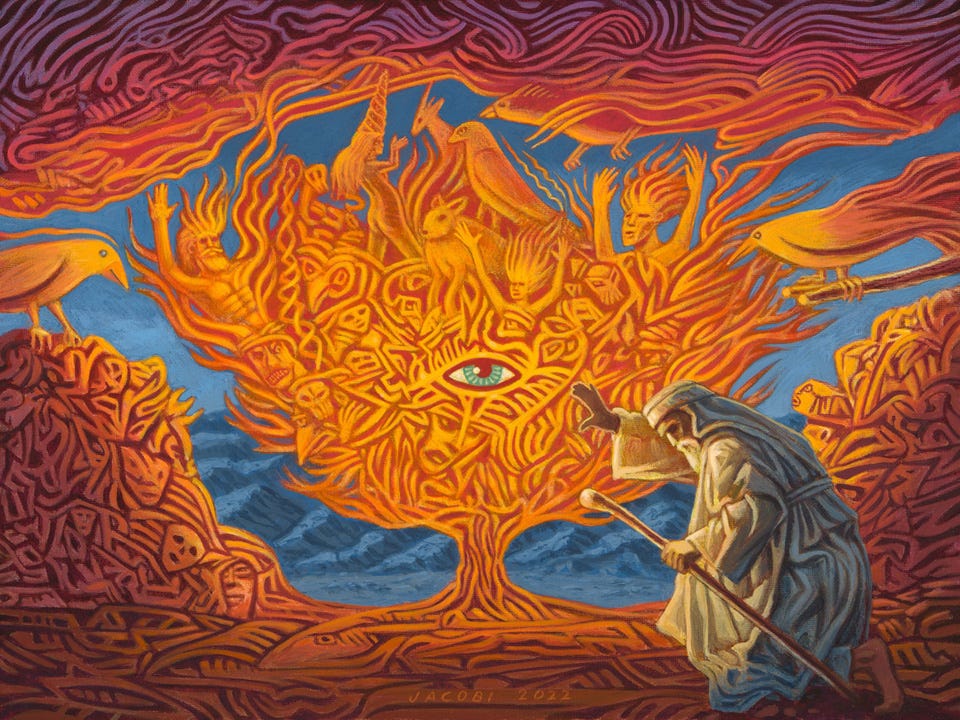
Jesus does not explain the storm. He announces himself.
“Take heart. I AM. Do not be afraid.”
The I AM who led Israel out of slavery and through the sea has come among us in the Son, not merely to still one storm, but to lead us out of the chaos of fear, sin, and death and into the freedom of God’s new creation. The God who once made a road through the water now comes walking across it.
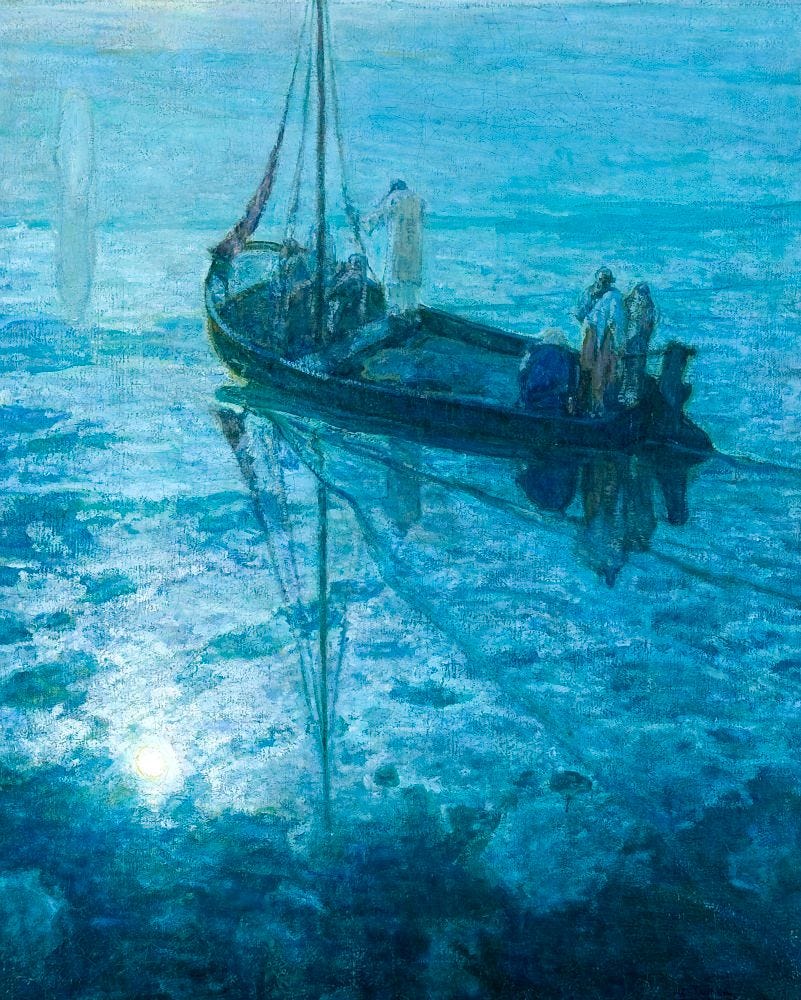
Then Peter speaks. “Lord, if it is you, command me to come to you on the water.”
Peter has taken a beating from preachers over the years. We love to say that Peter took his eye off Jesus. We love to use him as an illustration of what happens when faith falters. Peter has been sinking under the weight of sermon illustrations for 2000 years.
So, before we roast Peter, let’s give him some credit. He is the only disciple to get out of the boat. Eleven remained seated, and it was Peter who put his leg over the side.
Peter’s request matters too. He does not say, “Lord, let me perform an impressive religious parlor trick.” Instead, Peter says, “Command me to come to you.”
Peter wants to be where Jesus is. That is faith.
Faith is not certainty, composure, or the absence of fear. Faith is hearing Jesus say, “Come,” and putting one foot over the side while every reasonable part of you is saying, “This is a terrible idea.”
Jesus says, “Come,” and Peter walks on water. Do not miss that. Peter walks on water. For at least a few seconds, Peter does the impossible. He ventures out because Jesus has spoken a word and Peter trusts the word enough to move.
Then, as Peter is walking on the water, Matthew tells us that Peter “saw the wind,” which is a strange thing to say because you cannot see the wind. You can see what the wind does. A few weeks ago, I saw the wind rip a flag off the front of our house. At the same time, I saw the wind blow sheets of water down the street and topple our neighbors' recycling bin.
Peter sees the wind, becomes frightened, and begins to sink. And again, we are tempted to make Peter the villain.
Peter cries out, “Lord, save me!” That might be the most honest prayer Peter or anyone else has ever prayed. No religious throat clearing or eloquent explanation. Just a cry for help, “Lord, save me!”
Matthew says that Jesus “immediately reached out his hand and caught Peter.” Notice, Jesus did not tell Peter to kick harder or correct his negative thinking. Immediately, Jesus reached out.
The gospel is not a set of instructions for people who could save themselves if they tried harder. The gospel is an announcement, the announcement for the lost, the last, the least, and the dead. Or, in Peter’s case, the drowning.
Jesus reaches down and grabs Peter. That’s the center of this story.
Peter is not saved because he is motivated to be saved or because he walked on the water. Peter is saved because Jesus has a grip on him.
Throughout high school and college, I was a lifeguard and lifeguard instructor. I know that drowning people do not make good partners in their own rescue. They flail. They panic. They swallow water and throw up on themselves and their rescuer. They need someone to reach out and grab them.
So, the good news is not that Peter has a strong grip on Jesus. The good news is that Jesus has a strong grip on Peter.
Jesus says, “You of little faith, why did you doubt?”
Not, “You of no faith.”
Peter has faith. It might be soaking wet and frightened, but he has faith. Faith with water in his lungs. A little faith is still faith when it is held by Christ. The strength of our faith is not found in our own strength. It is found in the faithfulness of the One who reaches out his hand.
Matthew makes this point through the end of his gospel. After the resurrection, the disciples see Jesus, and Matthew adds, “but some doubted. Even after Easter. Even after the worst thing was not the last thing, some doubted. And Jesus still sends them to the world in his name.
When Jesus and Peter climb into the boat, the wind ceases. Only then do the disciples say, “Truly you are the Son of God.”
They do not need the correct confession to be rescued. They confessed who Jesus is because he has already rescued them. Worship is not the price of grace. Worship is what happens when grace climbs into the boat.
So, maybe you are in a boat. I have met with enough of you over the last month to know that you probably are. And if you are not, then you probably have been. Rowing hard and getting nowhere. Or, you stepped out and discovered that your faith is not as impressive as you hoped. Or, you are already sinking and have nothing left except the plea, “Lord, save me.”
That is enough.
Jesus does not wait for calm waters. He comes to the frightened disciples. To doubters, to sinners, to those who are tired of treading water or are wondering why even try, and to us he says, “Take heart. I AM. Do not be afraid.”
Amen.
[i] Genesis 1:1-2
[ii] Exodus 3:13-14


