


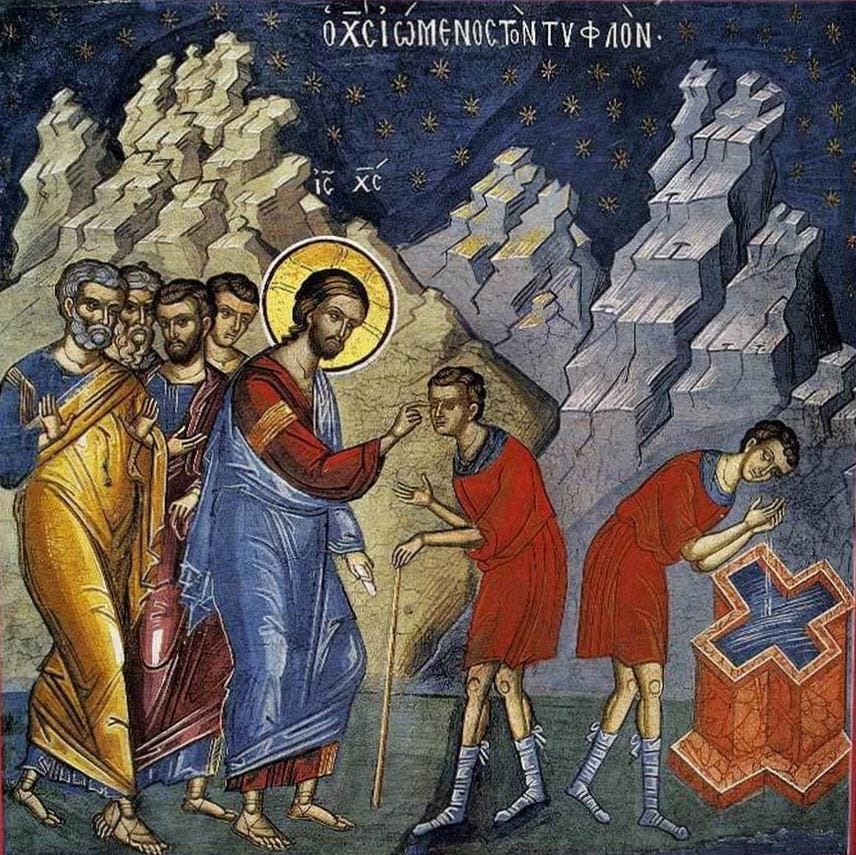
Last Sunday we had mud. Jesus smeared mud over the eyes of a blind man. Mud made from Jesus’s spit and centuries-old dust. Spit mud sounds like foolishness, but then, the blind man goes to a pool, washes his face, and his sight is restored.
This week, the man has returned to his community, and instead of singing “Praise God, from whom all blessings flow,” there are questions.
“Is this not the man who used to sit and beg?”[i]
“Isn’t that the man we ignored? You remember him, the sinner.” Which is the polite way of saying, “We preferred you the way you were.”
The neighbors are not debating whether blindness is bad. They are debating whether the changes are real: “‘It is he.’ Others said, ‘No, but he is like him.’ He kept saying, ‘I am the man.’”[ii]
The last part of verse 9, “I am the man,” may be the most courageous line in this scene. Because the healing forced the man to claim a new identity in public. He can no longer hide behind his old story or identity. God has interrupted the narrative and given a new identity.
This is what the evangelist wants us to see: when the gospel rearranges a life, the first response is not applause. It is suspicion.
Lent exposes that.
We say we want transformation. We pray for renewal. We march for peace. We sing about amazing grace. But when grace actually changes someone, when the anxious become brave or the bitter one softens, or the addict gets sober, or the quiet one finds their voice, we squint.
“Is that really them”? we ask.
The suspicious neighbors escalate the situation and go to the Pharisees. The Pharisees are the serious church people. They care enough about God to get anxious when God starts acting without clearing it through the proper channels. When something or someone does not fit or meet expectations, committees call meetings. We consult experts. We ask for an official ruling.
John drops a detail that shifts the focus: Jesus made the mud on the Sabbath. Of course, it was the Sabbath. Grace has terrible timing. It does not check the liturgical calendar before acting. Grace does not submit a proposal to the committee on the appropriate use of spit-mud.
The issue at hand shifts from sight to Sabbath.
“Some of the Pharisees said, ‘This man is not from God, for he does not keep the Sabbath.’”[iii]
We need to be fair. The Sabbath mattered then, and it matters today. It was, it is a gift and a command and a resistance against slavery. The Pharisees are not cartoon villains twirling their mustaches. They are trying to be faithful. But somewhere along the way, the gift became a gate.
The Sabbath was meant to liberate. It was supposed to be a testimony to God’s faithful provision. But today, in this scene, it is being used to question the idea of liberation.
And there it is, the ecclesial temptation.
We are very good at protecting our faith. We know the church’s rules. We know our doctrines and procedures. We know how to get things done. Those are not bad things. Order is not the enemy.
But Lent poses an uncomfortable question: when Jesus starts making mud outside the Temple, that is, outside our expectations and preferred patterns, do we rejoice? Or, do we reach for the rulebook?
The Pharisees reason clearly. If Jesus breaks the Sabbath, as they understood the command, he cannot be from God.
Others push back, asking, “How can a sinner perform such a sign?”[iv]
There was division. Grace exposes our fault lines.
Here’s the irony: the only person in the room who speaks with clarity is the man who used to be blind. He’s asked, “What do you say about him?” He’s being forced to see with clarity and to interpret his own healing. He is not trained. He does not have a seminary degree. He has not written a Substack essay on observing the sabbath. All he has is spit, mud, and memory.
“He’s a prophet,”[v] the man says about Jesus.
Last week, the healed man said, “The man called Jesus.”[vi] Now, under pressure, his confession grows.
Conflict clarifies, and the man sees better than the Pharisees. Not because he is smarter or is more disciplined. But because he has been disrupted by grace.
Spiritual growth is disruptive.
It disrupts the self. The man no longer has to live off the script of, “I am a blind beggar.” He must now claim a new identity.
His new identity disrupts the neighborhood. His neighbors can no longer keep him in the margins where he was manageable.
There is a new status quo. The religious authorities cannot easily categorize a God who heals on the wrong day of the week.
Because Lent is a holy invitation to holy disruption, we are asked what part of our lives is quietly invested in staying the same? Where have we confused stability with faithfulness? Where are we more committed to being “right” about the Sabbath than rejoicing that someone can see?
And before we get too comfortable slinging mud at the Pharisees, remember this: John’s gospel is written to believers. This is not a story about “those people.” It is a mirror for the Church.
We can be so certain that we see clearly that we miss the miracle standing in front of us. We can be so eager to guard orthodoxy—right belief—that we forget that the Word became flesh, not a policy or manual. We can be so invested in how we have always done it that we fail to notice that someone who used to be blind is now looking us in the eye.
The healed man’s clarity will cost him, but better the discomfort of sight than the comfort of managed blindness.
Lent exposes the places where we resist the gospel, not because we hate Jesus but because we fear what his healing will rearrange.
And here is the quiet mercy: Jesus is not threatened by the Pharisees’ suspicion or undone by their division. He keeps healing. He keeps revealing.
All of that to say, if Lent unsettles you, if it disrupts patterns or pride, that may not be failure. It may be sight.
And better to be a little destabilized by grace than perfectly stable in the dark.
Amen.
[i] John 9:8
[ii] John 9:9
[iii] John 9:16
[iv] Ibid.
[v] John 9:17
[vi] John 9:11


