

Rome Called it Peace Too
Pax Romana, Pax Christi, and the Words We Choose

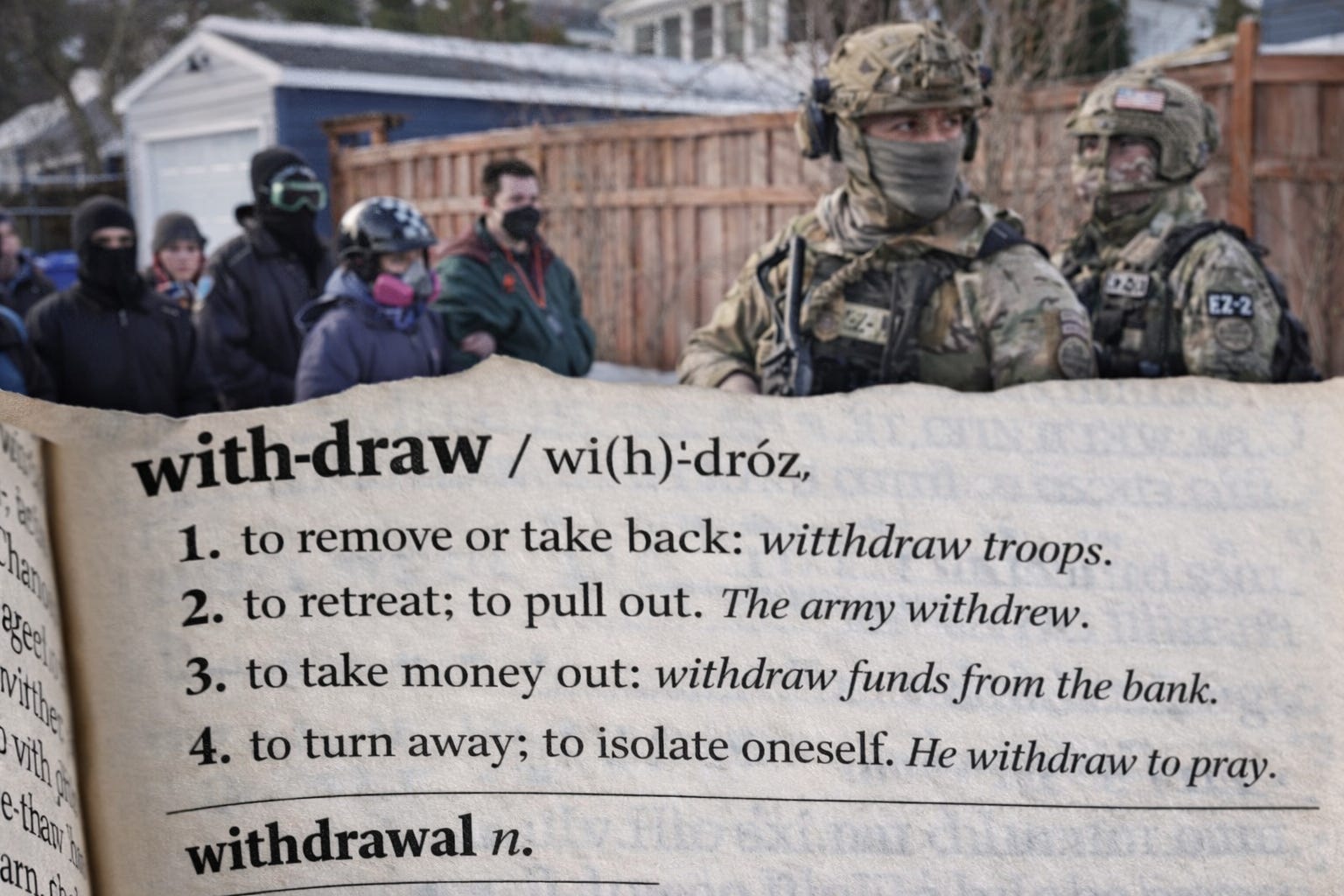
To hear that 700 federal agents are “withdrawing” from the streets of Minneapolis, MN, is, on its face, good news. Any reduction in force and step away from escalation is worth receiving with gratitude. And yet I cannot shake the language being used to describe what happened in Minneapolis.
“Withdraw.”
It is a word I associate almost exclusively with war. In recent memory, we can recall American troops’ final withdrawal from Afghanistan. More recently, Ukraine has been longing for the withdrawal of Russian troops from its borders. Forces withdraw when a battle has shifted, or a mission has been successful or failed. Watching the images out of Minneapolis frightened civilians, armed federal agents, weapons of war deployed in residential streets, I feel less like I am watching a domestic response and more like coverage from a foreign conflict. The language matched the images. That should trouble us.
A friend of mine, Dennis, who is a Pastor and lives in Minneapolis, put it plainly. “Living here in Minneapolis,” he said, “I can tell you it feels like an occupation.” That sentence should stop us in our tracks. “Occupation” is not supposed to be a word that applies to American cities. And yet it is the word that fits both the feeling on the ground and the language used from a distance.
Because words do not merely describe reality. They shape it.
When President Trump or Tom Homann says agents will “withdraw,” we imply that a battlefield existed in the first place. When neighborhoods are “secured,” people living there are quietly reclassified as threats. When civilians become “agitators” or “rioters,” fear begins to sound like wisdom. This is not semantic nitpicking. It is moral vigilance. Language has a way of making the unthinkable feel reasonable, even responsible.
I am thankful for de-escalation. But relief is not the same as resolution. A withdrawal suggests a pause, not repentance. It leaves unanswered the deeper question of why a militarized response was deemed appropriate in the first place and how easily so many of us accepted it as normal. Wars, after all, are always happening somewhere else to someone else. War language helps us look away.
This is where the gospel presses in and refuses to allow us to remain comfortable.
Empires have always promised peace through force. The Roman Empire even gave it a name. Pax Romana or peace secured by the sword, enforced by legions, maintained through occupation and fear. It was law and order in the empire at any human cost. Quiet streets bought with submission and blood. It worked, as long as Rome’s victims stayed invisible.
The kingdom of God speaks a different language altogether.
In the gospels, power does not arrive armored, and peace is not enforced at the end of a weapon. Christ was born and laid in a manger, and on Palm Sunday, he entered Jerusalem on the back of a colt. And tellingly, the only time we regularly hear of Jesus “withdrawing” is not to escalate force but to pray. He withdraws to lonely places, to the mountains, to be alone with the Father.
Most strikingly, Jesus “withdraws” just before he is arrested.
On the eve of his betrayal, he does not deploy disciples, nor does he ask Peter to (much to Peter’s disappointment) secure the perimeter. He withdraws to Gethsemane. Jesus did not withdraw to plan a counteroffensive but to pray. Not to protect himself but to surrender himself. His withdrawal is not strategic. It is an obedient, quiet refusal to meet violence on its own terms.
If Rome offers Pax Romana, Jesus embodies something else entirely. The Church calls it Pax Christi. A peace that does not come by occupation but by incarnation.
Pax Christi peace that does not dominate bodies but heals them. It does not silence dissent but absorbs violence into love and refuses to let it have the final word. Rome’s peace depends on who is afraid and who is armed. Christ’s peace depends on who is willing to be wounded. One clears streets. The other carries a cross.
The Kingdom of God advances not by domination or fear but by nearness, and the love of God stays put even when suffering draws close. Jesus does not conquer by clearing streets. He conquers by giving himself up for the life of the world. If this is power, it is the world that keeps mistaking it for weakness.
That is why war language should trouble Christians most of all. It reveals how quickly we forget what kind of king we follow and what kind of kingdom we are called to witness to. When the church grows fluent in the language of force, it does not become more effective. It becomes confused about who it belongs to.
If words matter, and they do, then so does what we choose instead. Not “withdrawal” but mercy. Not enemy but neighbor. Not control but care.
The language we use now will help decide whether moments like Minneapolis become warnings we heed or rehearsals for what comes next.
God of true peace, teach us to distrust the calm that comes from force and to follow instead the costly peace of Christ that refuses fear, stays near, and bears the wounds of the world. Amen